
Trust Is the Asset: How Purpose-Led Brands Are Building It Through Sustainability.
Trust is what brands need most, and sustainability communication is one of the best ways to build it. A new roundtable report from the Anti-Greenwash Charter brings together nine purpose-led brands, including COOK, Huel and Tony’s Chocolonely, to unpack what earns that trust, and what quietly erodes it.
Date: September 2026
Read time: 5 mins
Author: AGC
Trust is becoming the thing brands need most.
In a market where customers are increasingly wary of overstated claims, sustainability communication has become one of the most effective ways to earn that trust, or lose it.
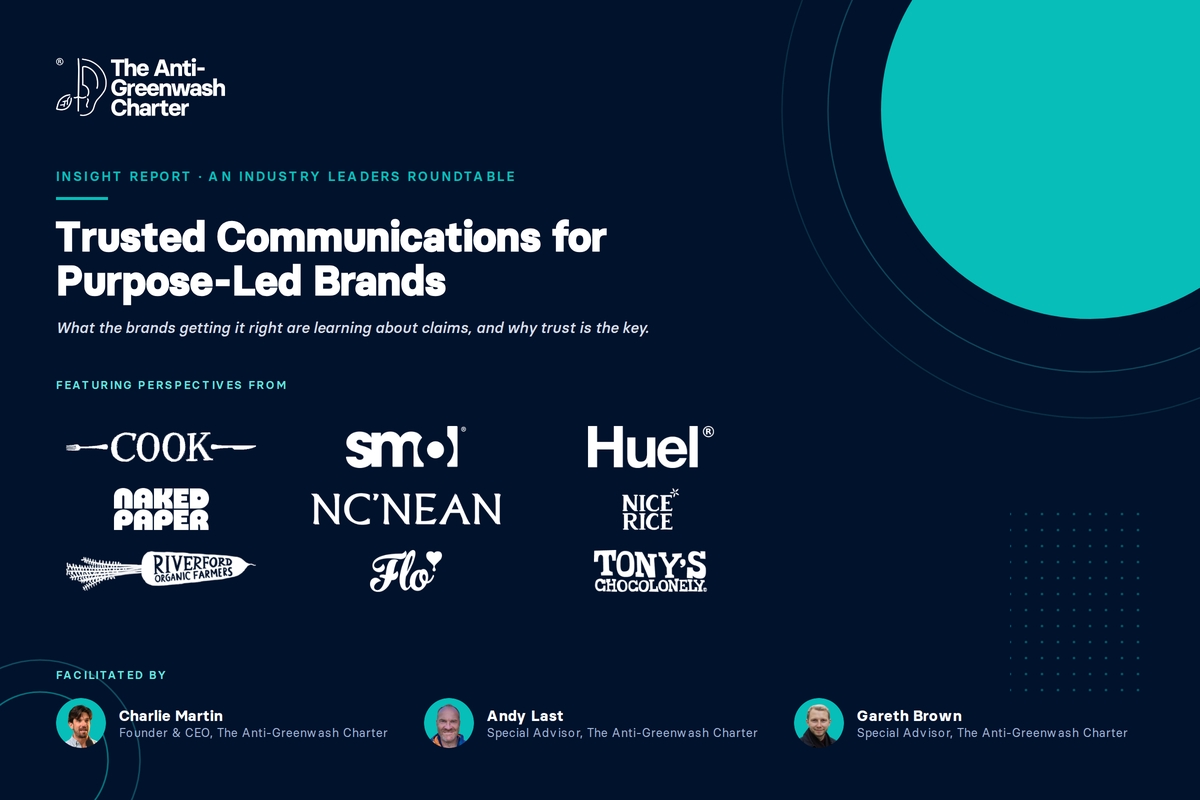
This summer, the Anti-Greenwash Charter brought together representatives from nine purpose-led consumer brands, including COOK, Huel, Riverford Organic and Tony’s Chocolonely, to explore what confident, evidence-based sustainability communication actually looks like in practice.
What came out of the room was not a set of new rules. It was a shared account of what earns belief.
Why sustainability carries so much weight
Every brand at the table was founded on the idea that reducing its impact matters. That makes the standard applied to its sustainability claims more than a technical detail. It becomes part of how the whole brand is judged. Get one claim wrong, and customers do not just question that claim. They start questioning the next one too, about quality, about ingredients, about anything the brand says.
Credibility does not sit in a separate compartment marked “environmental.” It travels.
The regulatory backdrop makes this more pressing, not less. The Competition and Markets Authority gained direct consumer-enforcement powers under the Digital Markets, Competition and Consumers Act in April 2025, and the EU’s Empowering Consumers Directive will restrict specific claim types, including vague terms like “eco-friendly” and offset-only carbon-neutral claims, from 27 September 2026.
But the room’s focus was not on the compliance floor. It was on the ceiling, the opportunity to build lasting trust with customers.
What builds it
Several practices came up again and again. A track record of responsible practice gives a brand room to correct a limited error without losing customer confidence, though that protection has limits. Precision does more work than breadth: a specific, product-level claim tied to a clearly defined boundary tends to hold up better under scrutiny than a broad percentage claim that only needs one exception to unravel.
The most striking theme was a willingness to disclose what is not yet fixed. Rather than waiting to be found out, several brands are proactively naming gaps in their own supply chains alongside the remediation underway. One participant explained the logic:
“Being open about the challenges we’re facing preempts reputational issues, rather than creating them.”
That kind of honesty does something a polished claim cannot. It shows the audience the brand can be trusted with the parts of the story that are still unresolved, not just the parts that are finished.
Where it gets fragile
The room was equally candid about where trust breaks down internally. Impact reports, ESG disclosures and certification data hold the evidence behind a claim, but that evidence has to survive translation into short, customer-facing language.
Participants described a recurring failure point: as material gets shortened for a brief or a headline, the scope and qualifications that made a claim defensible can quietly go missing.
The brands addressing this potential weakness well have closed that gap by bringing sustainability and marketing teams together from the start of the process, not at the handoff, so the evidence is built into the message rather than fitted around it afterwards.
A shared standard
Across on-pack communication, marketing and reporting, the practices described in the room map closely onto four familiar principles: transparency, accountability, fairness and honesty. A living claims policy that every voice speaking for the brand is briefed against. A two-pass review that checks accuracy before it checks tone.
A simple test applied before anything goes out: would this claim survive a conversation with a consumer, a retail buyer and a regulator, in that order.
None of this is about saying less for its own sake. It is about saying only what can be backed up, and being confident enough in the evidence to say it clearly.
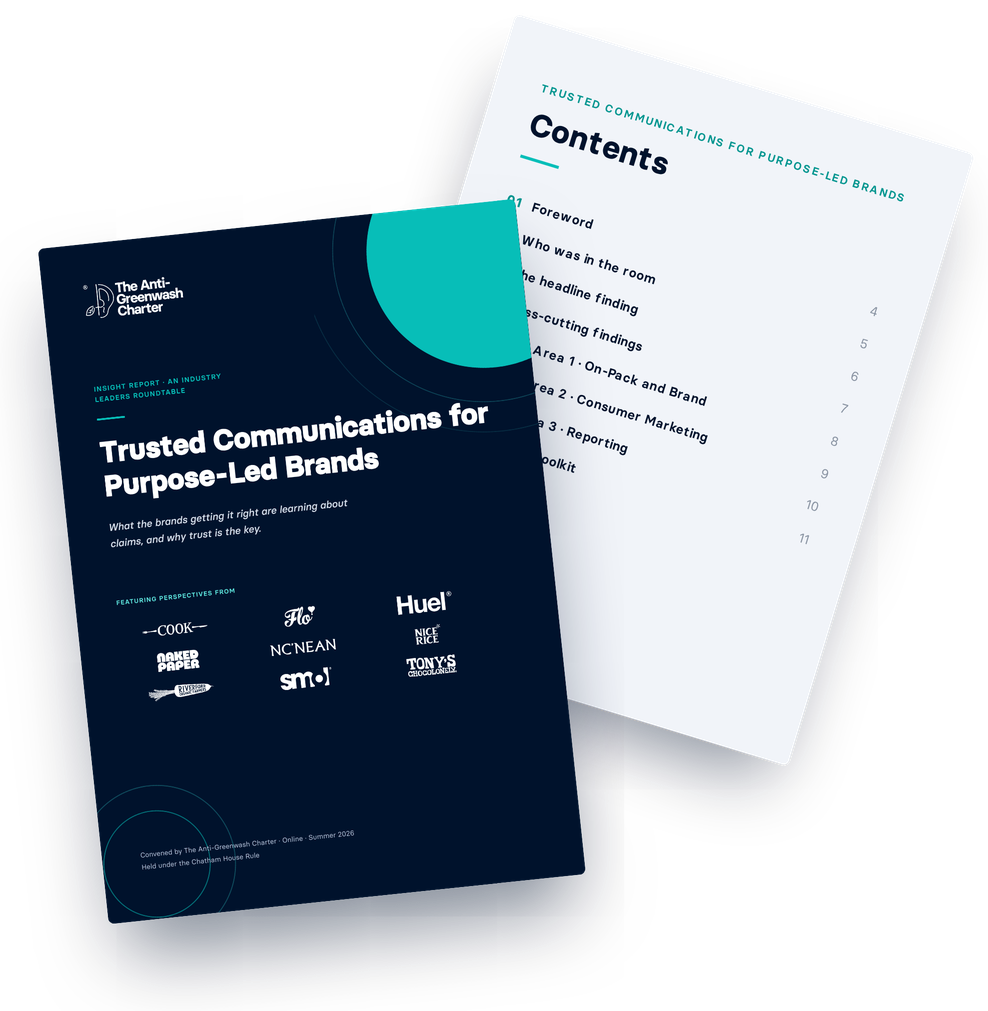
The full roundtable report, including practice points and resources for each focus area, is available to download here.
Be Recognised for Responsible Marketing and Communications
👉 Become a signatory of The Anti-Greenwash Charter.
Shape the future of responsible communication and show stakeholders what trusted sustainability leadership looks like.