

Trust Is the KPI That Changes the Conversation
Greenhushing is not driven by apathy. It is driven by uncertainty. When organisations focus on trust as the outcome, communication becomes clearer, more consistent, and ultimately more credible.
Date: March 2026
Read time: 5 mins
Author: AGC
Greenhushing is often misunderstood.
It is easy to assume that organisations stay quiet because they have something to hide, or because sustainability is not a priority. In most cases, neither is true.
The hesitation comes from a more practical concern. Organisations are unsure how their words will be received once they leave their control.
They are working with information that is still evolving. Progress that is real, but incomplete. Language that is expected to be precise, but often interpreted without context.
In that environment, communication carries risk.
So the instinct is to reduce exposure. To wait. To say less until the ground feels firmer.
This is not a failure of ambition. It is a response to uncertainty.
The Decision Behind the Silence
Inside organisations, sustainability communication rarely breaks down in a single moment. It slows gradually.
A team prepares an update. It reflects genuine progress, but also acknowledges complexity.
Questions follow. Is the evidence complete? Could the language be misinterpreted? Does this create unnecessary risk?
Each question is reasonable. Each reflects a different responsibility.
But together, they shift the decision.
The threshold for saying something becomes higher than the threshold for saying nothing.
Silence, in that context, is not strategic. It is the path of least resistance.
Why More Rules Do Not Solve It
The natural response to this tension has been to introduce more frameworks, more guidance, more disclosure requirements.
These have their place. They create structure and improve consistency.
But they do not resolve the underlying issue.
Because the challenge is not simply what organisations are required to say. It is how confident they feel in saying it.
You can increase the volume of reporting without increasing the quality of communication. You can meet disclosure requirements and still avoid explaining what matters.
Without trust, compliance becomes a ceiling rather than a foundation.
Reframing the Objective
The shift begins when organisations change what they are aiming for.
If the objective is to avoid criticism, the safest approach is restraint. If the objective is to build trust, the approach has to be different.
Trust is not built through perfection. It is built through consistency and clarity.
It comes from explaining decisions, not just outcomes. From acknowledging limitations, not just highlighting progress. From using language that reflects reality, even when that reality is still evolving.
This requires a different kind of judgement.
The question is no longer whether a statement is technically safe. It is whether it is meaningfully credible.
When Silence Becomes a Signal
For a time, saying less can feel like a way to manage risk.
But silence does not sit in isolation. It is interpreted.
When stakeholders cannot see how progress is unfolding, they fill the gaps themselves. When communication is limited to formal disclosures, it becomes difficult to understand intent, direction, or accountability.
Over time, the absence of communication begins to shape perception as much as the presence of it.
What was intended as caution starts to look like reluctance.
And at that point, the balance shifts. Silence no longer reduces risk. It creates it.
The Missing Link Is Consistency
Most organisations do not lack principles. They lack a consistent way to apply them.
One team may prioritise precision. Another may prioritise clarity. A third may focus on risk.
Without alignment, each message is reassessed from the beginning. Each decision is reopened.
This creates friction. It slows communication. And it often leads back to the same outcome: saying less.
Consistency is what turns good intent into reliable practice.
The Role of a Shared Standard
This is where an independent standard becomes valuable.
Not as a constraint, but as a point of reference.
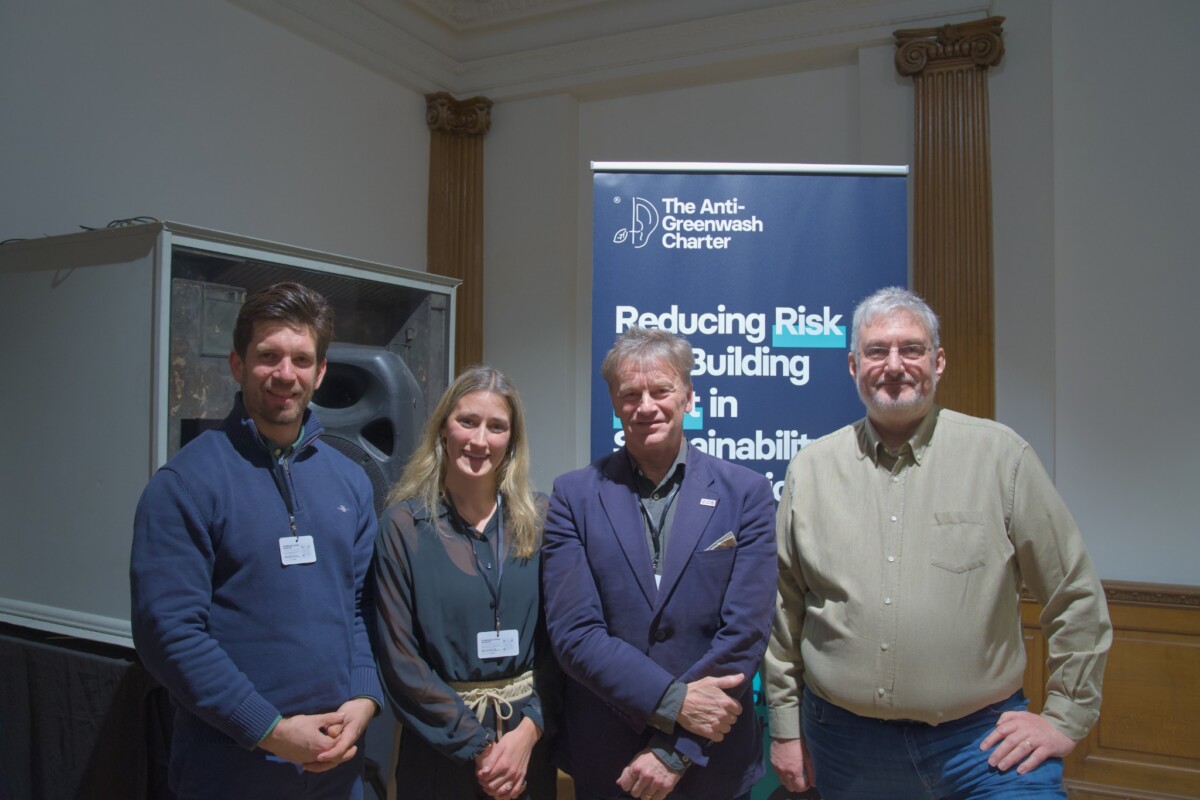
The Anti-Greenwash Charter provides a framework grounded in four principles: Transparency, Accountability, Fairness and Honesty.
These principles do not eliminate judgement. They guide it.
They help organisations explain progress without overstating it. To acknowledge complexity without creating confusion. To communicate in a way that is both clear and credible.
Most importantly, they create alignment.
When teams are working from the same standard, decisions become more straightforward. The boundaries are clearer. The trade-offs are understood.
From Uncertainty to Confidence
When that structure is in place, something shifts.
Communication becomes less about avoiding risk and more about managing it intelligently.
Discussions become more focused because the objective is shared. Decisions become more efficient because the criteria are clear.
And confidence begins to build.
Not because uncertainty disappears, but because it is handled more openly.
This is what changes the role of communication.
It moves from being a point of tension to a source of credibility.
And in that shift, greenhushing begins to fall away. Not because organisations are told to share more, but because they have a clearer, more trusted way to do so.
Sustainability Communications with Confidence
If your organisation wants to protect its reputation, reduce greenwashing risk, and communicate sustainability with confidence, we’d love you to join us.
📢 Become a signatory of The Anti-Greenwash Charter.
Shape the future of responsible communication and show stakeholders what honest, trusted sustainability leadership looks like.