
How The Anti-Greenwash Charter Safeguards Best Practice in Sustainability Communication
Certification is only as credible as the process that keeps testing it, here’s how the Charter ensures its signatories continue to meet the standard they signed up to.
Date: August 2026
Read time: 3 mins
Author: AGC
Any independent standard is judged on more than how carefully it’s awarded in the first place. It’s judged on whether that standard is kept up afterwards.
This isn’t unique to the Anti-Greenwash Charter. B Corp, for example, requires companies to recertify regularly, and now includes independent checks as part of that process.
The idea is a simple one: a mark only means something if it keeps being tested, not if it’s handed out once and forgotten.
The Charter follows the same principle, using two processes built specifically for sustainability marketing and communications.
The Campaign Review
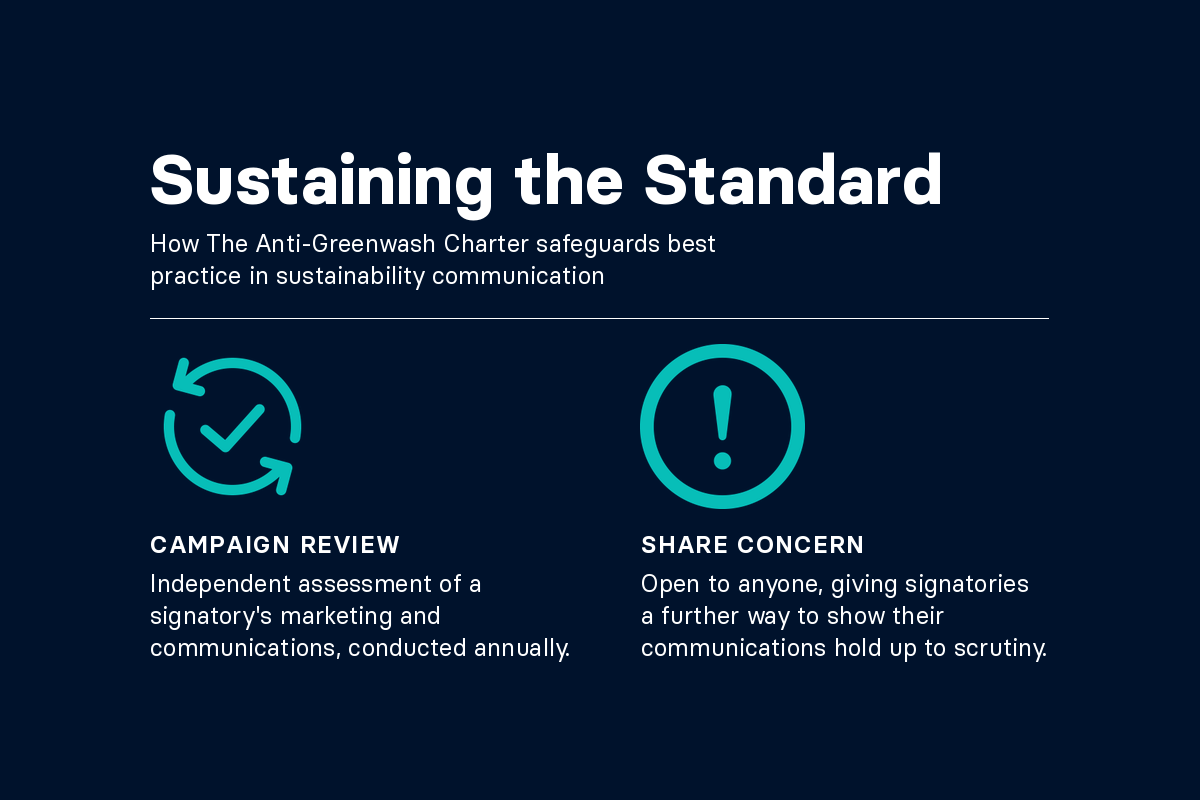
The main process is the Campaign Review. This is an independent check of a signatory’s marketing and communications, measured against their own Green Claims Policy.
Reviews happen every year.
Reviewers check whether claims are backed up by evidence, whether the right internal approval process was followed, whether staff understood the rules they were working to, and whether the language, images and data used were fair rather than misleading.
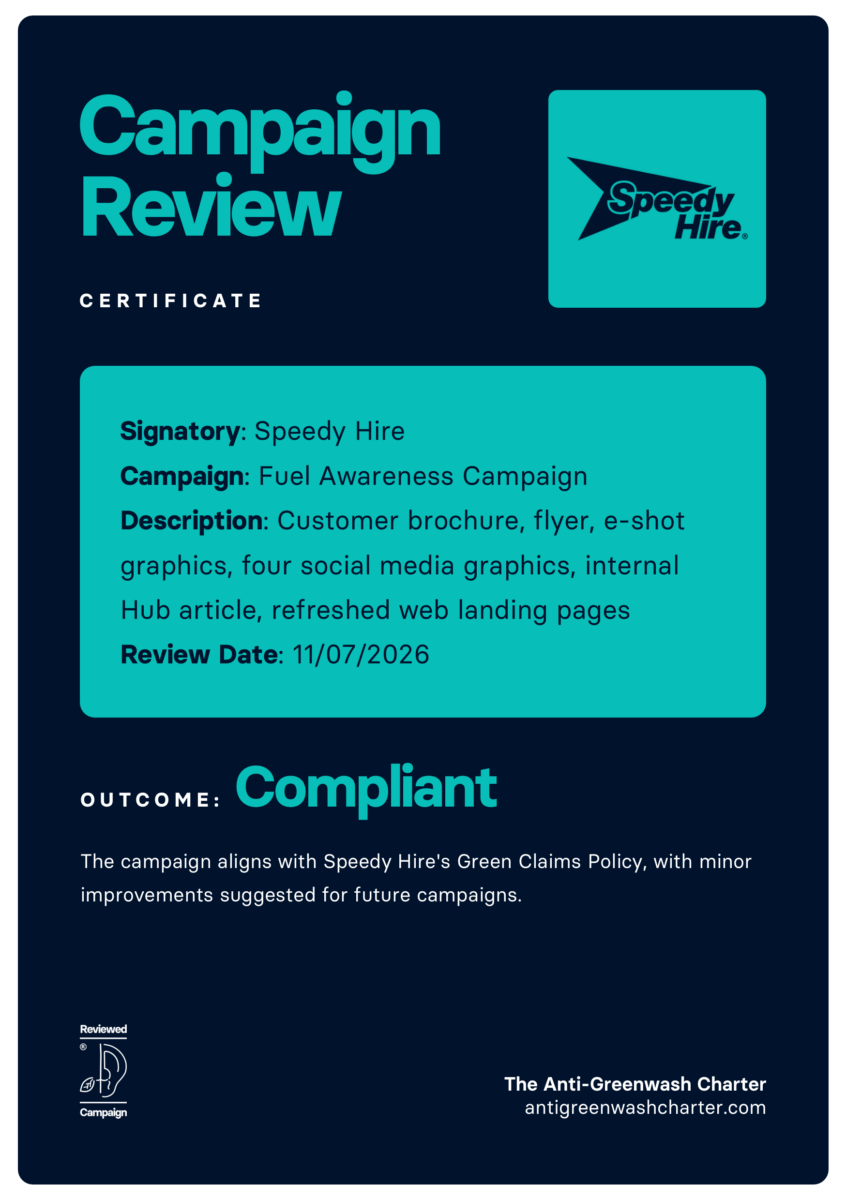
Every completed review is marked with a certificate (see example below), confirming it happened and what the result was.
Every report, whatever the result, is added to the signatory’s Green Claims Policy. Over time, this builds a running record, so anyone can see a signatory’s history of reviews, not just a single snapshot.
What happens when something’s wrong
Reviews can end in one of three ways: compliant, compliant with recommendations, or non-compliant. If a campaign is non-compliant, the signatory has to fix the issue straight away.
One non-compliant result doesn’t mean a signatory loses their status. It simply means the process has done its job: spotted a gap between a claim and the evidence for it, and required that gap to be closed.
Things change if the problem keeps happening.
Two non-compliant reviews in a row, or a serious breach of the standards, can lead to a signatory losing their status altogether.
This balance is intentional. It accepts that getting everything right first time, on a genuinely complicated subject, isn’t realistic. But it also means that if problems keep repeating, there are real consequences.
Checks from outside: the Share Concern process
Campaign Reviews happen on a set yearly schedule. The Share Concern process gives signatories a further opportunity to demonstrate the strength of their communications, open to anyone, at any time.
Anyone, a customer, a competitor, a member of the public, can raise a concern about a signatory’s communications directly with the Charter.
Signatories join the Charter because they are already committed to being fair, transparent and evidence-led communicators, so the process gives them a way to show that commitment holds up under scrutiny, not just to claim it.
Each concern is investigated properly, checked against the signatory’s own policy and the Charter’s standards, with extra evidence gathered where needed.
In 2026, the Charter received one such concern. Without going into the details of the case, a full investigation was carried out. It confirmed that the signatory hadn’t broken their own policy or gone against the Charter’s standards.
The investigation did identify some room for improvement, and recommended changes to strengthen their communication further.
This shows how the process is meant to work for our signatories, who take their commitment to responsible practice seriously. A concern doesn’t need to prove wrongdoing to be worth investigating properly, and being willing to be questioned, and to keep improving as a result, is itself a mark of the calibre of communicator that chooses to sign up to the Charter.
Why this matters
The Anti-Greenwash Charter isn’t a regulator and doesn’t claim any legal power. It’s an independent standard that organisations choose to sign up to, and that choice says something in itself. Signing up means being confident enough in your own communications to have them checked, repeatedly, by someone outside your organisation.
What makes that standard mean something is the work behind it: reviews every year, a visible record of results, clear consequences for repeated problems, and an open door for anyone to raise a concern.
Put together, this isn’t just paperwork. It’s what allows the Charter’s mark to stand for something important: proof that a signatory is a strong, confident communicator, and still meeting the standard today, not just when they first signed up.
Be Recognised for Responsible Marketing and Communications
👉 Become a signatory of The Anti-Greenwash Charter.
Shape the future of responsible communication and show stakeholders what trusted sustainability leadership looks like.